February 18-20th
I can remember when I was 16, I arrived in Sydney, as an exchange student, in January. It was -40 Celsius in Calgary when I left and +30 Celsius Down Under when I arrived. I can faintly remember the opera house and not much else. I returned to Australia 10 years later, and if my friend and I spent any time here, I can’t recall it. This time was different. After 4 sea days getting there and then another 5 after we leave, I was determined to get on land as much as I could.

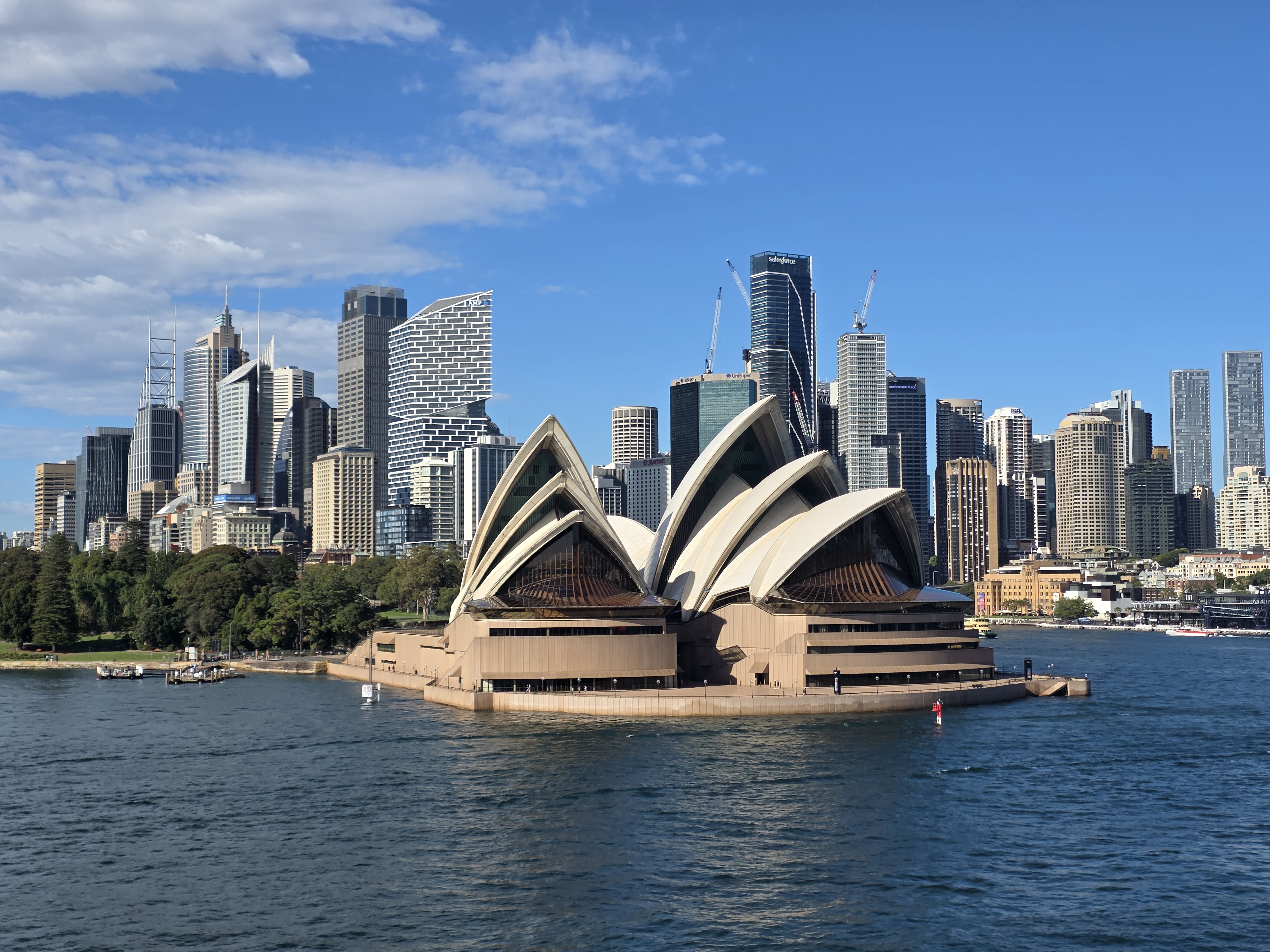
Our ship’s sail-in happened at 8 am, so we were able to stand on the bow and watch Sydney and its surroundings roll in closer. The sun finally reached the Opera House and Bridge as we approached them.
The Harbour is too shallow in several spots, so we had 4 tug boats tied to us and making sure we wouldn’t run afoul of anything.
Ironically, once we were cleared, I headed off to Circular Quay Wharf to hop on a ferry heading out the way we had just come in. It is not near. There are taxis, Ubers, and even public buses, but the buses have to be picked up about a 20-minute walk from the port. Wanting to get started, I caught an Uber for $25Aus.
The hop-on-hop-off ferry cost $38 Aus, and now that I’ve done it, it is a waste of money. People can catch ferries going directly to the same places for about $1 each trip. I only got off in Manly (because of the later rain), so I could have done the same thing for only a couple of dollars.

While waiting for our ferry, we went across the light rail tracks to check out Herald Square and the sculptures, Tank Stream Fountain.
The Ferry did go past Fort Denison in the harbour, which was once the remote prison referred to as Pinchgut due to a lack of provisions. I can’t even imagine how horrific a bad storm would feel out there.

Manly is about 40 minutes away after stopping at the Taronga Zoo and Watson’s Bay.

My goal was to visit the 4 Pines Brewery at Manly Bay for lunch and then make my way back to Watson’s Bay for a short walk. While I made it to 4 Pines and even a quick stop at Felon’s while waiting for the ferry, it began raining quite heavily, so I decided not to get off in Watson.

Back in Sydney, I decided to make one more stop at Blackwattle Distilling Co for free tastings of the local gin and vodka before going back to the ship for dinner. Mark was super generous, and 90 minutes later, I had sampled way too much alcohol. Mark closed up the shop for the night and gave me a short ride to the port.

Day two, I headed off at 7:30 (gotta beat the heat) and decided to walk into the city core. This involved walking out of our harbour to the ANZAC Bridge (40 minutes). This bridge is noticeable from just about anywhere in Sydney and joins Pyrmont and Glebe Island. It was built in 1995, with a 345-meter main span on pillars 120 meters above the water.

On the western end, where I started the walk across, are two bronze statues representing an Australian soldier and a New Zealand soldier.

Going down the walkway on the Pyrmont side of the bridge is an apartment complex where a troop of parrots was playing on a balconey. At first I thought they were visiting, but since they were still there in the afternoon when I went back, I wonder if they live there.

Not too far away, I visited the Pyrmont firestation. It was completed in 1906, and it remains a fire station, although the warehouses that were once around it have been replaced with residential buildings.

From here I walked to Darling Harbour. This area, too, has undergone gentrification from a bustling working port to a pedestrian-friendly area with the Australian National Maritime Museum, restaurants, SEA LIFE aquarium, and the International Convention Center.

Spanning Cockle Bay in Darling Harbour is the Pyrmont Bridge. It was originally constructed to join the industrial wharf with the heart of Sydney in 1902, but was closed to traffic in 1981 and reopened as a pedestrian and cycle bridge.

Continuing straight from the bridge is George Street, Sydney’s oldest street. It was first laid out in 1788 to join the early settlement wharf and the government buildings. Most of the government buildings remain on George Street.
On the opposite sides of Druitt and George Street, I found the QVB (Queen Victoria Building and the Sydney Town Hall.
The QVB is a building that makes a statement. It is an entire city block made into a sandstone building in the Romanesque Revival style in 1898. Inside is 5 stories, with stained glass windows and mosaic floors, and it is topped with 5 domes. Outside is a statue of the Queen herself and a charity wishing well.

Across the way is the Sydney Town Hall, a grand example of Victorian-style architecture. It was constructed from 1869-1889.

Beside the town hall is Saint Andrew’s Cathedral. This building is Gothic Revival style and was constructed in 1868.

Leaving this section along Market Street is Sydney’s most notable landmark building, the Sydney Tower. It is 309 meters tall and was completed in 1981.

A couple of blocks from the tower is Saint James Church. It is the oldest surviving church building in the city. It was completed in 1824 in the Georgian style.

Across from St. James are the Sydney Mint and Hyde Park Barracks.

The Hyde Park Barracks sits across the entrance to Hyde Park and was opened as a dormitory for men building the roads, wharf, and public works in 1819. I love that it was designed by Francis Greenway, an architect who was a convict who ended up designing half the colony. It is now a UNESCO World Heritage Site.

Hyde Park is the city’s oldest public park and covers several blocks. The Archibald Fountain is the main attraction upon entering the grounds and can be reached from all 4 directions. It was unveiled in 1932 and features Greek mythology.

There are also statues of Captain Cook and James Martin.

On the southern end, the ANZAC War Memorial and Pool of Reflection stand. This building was opened in 1934 and dedicated to the servicemen and women of the Australian and New Zealand Army Corps.

On the Western side of the park is the Hyde Park Obelisk. It is a 22-meter sandstone monument that was built as a ventilation shaft for the city’s underground sewer system in 1857.

On the east side of Hyde Park and across from the Barracks is Saint Mary’s Cathedral. This is the same spot where the first catholic chapel went up in 1821. The cathedral was constructed in 1868, but its twin spires were finished in 2000.

Its interior is filled with stone columns and stain glassed windows.

The cathedral opens to gardens and Cathedral Square.

Across from this is the Australian Museum.

By this point, my feet were sore, and I began the walk back towards my ship, passing through Chinatown and the Chinese Friendship Garden.

By the time I made it back to Blackwattle, it was lunchtime, and I stopped off at Sydney Brewery for some pizza and beer. It was delicious.

I had a couple of hours of downtime before I needed to be back in the city center for a Rock’s tour.
The Rocks is Sydney’s oldest European-settled neighbourhood. In January 1788, the First Fleet came to shore to set up a British penal colony. This was a working waterfront where convicts and free settlers built their homes and workplaces.

It was a rough neighbourhood and was crowded, poor, and rife with gangs. In 1900, the bubonic plague outbreak triggered changes. Residents were forced out, the slums were cleared, and port facilities modernized. Again, in the 1970s, the green bans stopped the destruction of the area and the YMCA while building a new hostel uncovered original colony ground. The YMCA still built its hostel, but raised it over the site to protect the history of the area.

The Fortune of War Hotel has been pouring drinks in the area since 1828, and is one of Sydney’s oldest continuously licensed pubs. It is across the street from Circular Quay (where the ferries come and go), so it’s a popular stop for tourists.

We went up Nurse’s Walk to Harts Pub, where we were meeting our guide. Harts Pub was originally 3 residential homes that have been converted into a pub.

The Australian Hotel has been here since 1824, making it one of the oldest pubs. It even has the ladies’ parlour, where women could sit to have a drink away from the men in the main bar, where women were not allowed. This also meant that a male needed to bring them so that he could go to the main room to get the drinks.

We walked past the Argyle Stores (warehouses for goods built in the 1820-1870’s) and Playfair Street Terraces.

We stopped by another hotel, the Hero of Waterloo Hotel. This establishment has a resident ghost and a secret tunnel that connects the basement to the wharf, where rum could be smuggled, or the involuntary recruitment of sailors could be made.

Our final stop was the Lord Nelson Brewery Hotel. This hotel also competes for the title of the oldest continuously licensed hotel and pub brewery in Sydney. Its first license was in 1841. They brew their own beer in the back.

I had a new goal for day three. No more of the center of the city, instead I would head south towards Newton and Merrickville. Newton is supposed to be a popular place for street murals and trendy shops for the university crowds.

It took me about 90minutes to walk to Newton, but I went through a couple of parks, so the walk was a nice one. Once I hit the universities and hospitals, I knew I was close.


The “I Have a Dream” mural was painted in 1991 by artists Juilee Pryor and Andrew Aiken. Formal permission had been refused, but they did it anyway as a gift to the community and a humanist statement. In later years, the Australian flag motif was added. It suffered weathering and fire damage in 2011, but it was formally heritage-listed in 2014.

“Africa” is on the side of an African restaurant, and was painted in the early 1990’s based on a vintage map. It was refreshed in the early 2000’s.

The “Live Outside” mural was completed in 2017. It is tucked in a car park and can be easily missed.

“Hide and Seek” mural was painted by Australian artist Kyle Hughes- Odgers. It depicts a giant playing the game with three small children hiding in his pocket.


Nearby is the “Wyrd Sisters” mural. It was created by Ox King and depicts three witches.

A sci-fi mural, “The Emporer’s Daughter,” is a block down. It was done in 2015 by As One and taken from the Dune novels.

Along the same street are several murals, with a variety of styles and contents.
From here, I continued walking next door to Merrickville, home of the Inner West Ale Trail, commonly referred to as the “Golden Triangle.” A quick stop at the mall for some cheaper lunch, and I went to 3 of the open breweries in the area.
Kicks opened in 2023 and is better known for its IPAs. I considered it an average spot, with nothing outstanding or bad, just slightly above average.
Then I wandered to Mixtape Brewing & Bar. This one was my overall favorite in Sydney, with a funky old-school decor and a great variety on tap. Sadly, they do not do tasting paddles and do not have much of their stuff in cans, so I really only tried 3 of their beers.
Lastly, I wandered over to Pickled Monkey. The same guy owns Harts Pub, which I had visited the night before. The pub is named after a disturbing story that in the early 1900s, the biology department in Sydney ordered samples from Oxford University. When the barrels arrived, some Sydney warfies drank the pure alcohol from the barrels, only to find out that the barrels also contained picked monkeys for scientific research purposes. It doesn’t have the best reviews on Google, but the story made me go in. It was my least favorite of the breweries.
I would have loved to have gone to a few more, but sailaway time was coming, and I needed to get back to the ship. All in all, I feel like I made the most of my three days in Sydney.
Leave a Reply